
What Buyers Should Check in a Pet Car Seat Tether
A practical buyer checklist for pet car seat tether attachment, adjustment, harness compatibility, hardware, stitching, handling and sample evaluation.
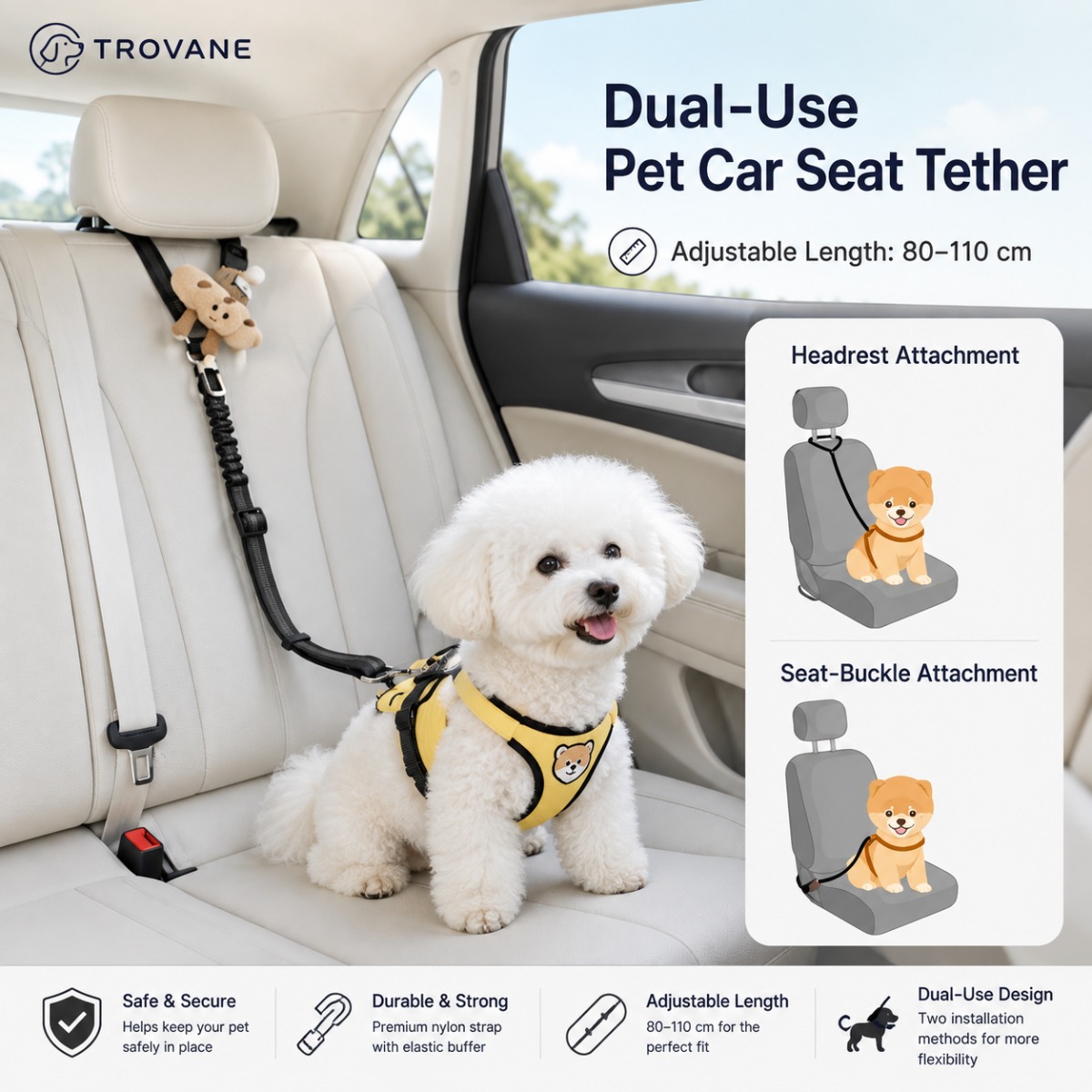
A pet car seat tether is a small accessory with several points that can affect everyday use. Buyers need to understand how it attaches, how much movement it allows, how clearly it adjusts and whether the hardware and stitching remain consistent after repeated handling. The right sample review focuses on the complete in-car routine rather than a broad safety claim.
Start with the attachment method
TROVANE’s Dual-Use Pet Car Seat Tether is listed with headrest and seat-buckle attachment options. That dual format is useful as a comparison point because it makes the first buyer question explicit: where is the customer expected to connect the tether in the vehicle?
An attachment method should be easy to identify, fit the intended vehicle setup and be explained clearly on the packaging. Buyers should operate every connection on a sample rather than relying on a product photo. Check how the component enters, locks, releases and stores when it is not connected.
Confirm the intended vehicle connection
Headrest loops and seat-buckle connections create different use patterns. Confirm which configurations are included with the exact model, whether the connection can rotate or loosen during ordinary movement, and what vehicle limitations need to be stated. Compatibility should be described specifically, not as a universal fit promise.
Define harness compatibility
The buyer should confirm the intended body-harness connection and make sure the hook can be attached and removed without forcing the gate. Do not assume that every harness attachment point is equally suitable. Product instructions should state the intended setup and should not encourage customers to improvise with incompatible collars or fittings.
Adjustment range should match the use case
The current product page lists an 80–110 cm range for the dual-use style and 55–65 cm for the single-use style. Those numbers help a buyer compare formats, but they do not replace a loaded in-car test. The useful length depends on the attachment point, the dog, the harness position and the space around the seat.
Move the adjuster through its full range several times. It should be easy for the customer to set but resistant to unintended movement after adjustment. Check whether excess webbing becomes tangled, reaches the dog’s feet or makes the product look unfinished at the shorter setting.
Control movement without making unsupported promises
A tether is meant to manage where a pet can move inside the vehicle, but a buyer should avoid describing any model as crash-tested, certified or suitable for every vehicle unless the required evidence exists. The TROVANE page describes an elastic shock-absorbing section and a 360-degree swivel hook; sample evaluation should confirm how those elements feel and behave in the actual configuration being considered.
Set the tether at several lengths with a realistic test load. Observe twisting, slack, rebound and contact with the seat or door area. The aim is to understand normal handling and customer expectations, not to simulate or claim performance in a collision.
Inspect webbing, hardware and stitching together
The published specification identifies nylon webbing, an aluminum-alloy hook and a plastic buckle. Review each material at the joins where loads and repeated handling are concentrated. The hook gate should move smoothly, the buckle should adjust without sharp edges and the webbing should pass through the adjuster without snagging.
Look closely at stitch placement
Compare stitch density, alignment and thread ends across multiple samples if possible. Reinforcement should be consistent around attachment hardware and adjustment components. A tidy surface is not enough if the stitch pattern changes from unit to unit.
Repeat the customer motions
Connect, adjust, rotate, disconnect and store the product repeatedly. Listen for squeaks, feel for rough movement and check whether coatings or finishes mark easily. Repetition often reveals problems that are not visible during a single inspection.
Ease of use includes storage between trips
Customers may leave a tether attached, move it between vehicles or store it in a glove box or travel bag. Check whether the hardware catches on nearby items, whether the webbing coils neatly and whether the product can be identified quickly when needed. Packaging should show the two installation options without making the first setup feel complicated.
Black, pink and custom colours are listed as available options. Colour can support a range, but it should not distract from clear operation. Instructions, adjustment markings and attachment diagrams need enough contrast to be useful in a vehicle interior.
Common complaints to investigate before listing
Most complaints in this category are likely to come from fit, operation or expectation gaps. Buyers should try to reproduce those gaps during sample review and make sure retail copy does not promise universal compatibility.
- The seat-buckle connection does not suit the customer’s vehicle.
- The adjusted length slips or leaves too much slack.
- The hook is awkward to connect to the intended harness point.
- The swivel or elastic section feels inconsistent during use.
- Webbing twists, tangles or sits poorly at the shortest setting.
- Instructions do not distinguish the two attachment methods.
A practical sample checklist
Treat the sample as a complete system: tether, attachment point, harness and vehicle position. Record the exact style and configuration so the approved reference is not confused with another length or installation option.
- Verify the included attachment styles against the product description.
- Measure the usable adjustment range on the actual sample.
- Confirm the intended harness connection and instruction wording.
- Cycle the hook, buckle, adjuster and swivel repeatedly.
- Inspect reinforcement stitching around every hardware join.
- Test storage and handling at both the shortest and longest settings.
- Remove unsupported certification or universal-fit language from listings.
Consider the surrounding in-car setup
A tether is only one part of the customer’s travel setup. Buyers reviewing how pets interact with an open window may also find What Makes a Practical Car Window Guard for Dogs? useful as a separate evaluation framework. The two products address different needs and should not be presented as interchangeable safety solutions.
Practical takeaway
Make the decision around real use
A useful car seat tether is easy to identify, connect, adjust and store. Buyers should compare the real attachment options, verify the stated length range and inspect the webbing, hardware and stitching through repeated use. Clear compatibility guidance is more valuable than a broad promise that cannot be supported.